
What is a CVE Vulnerability
CVE vulnerability (Common Vulnerabilities and Exposures) is a unique identifier assigned to known cyberthreats or security flaws in software and hardware. Each such vulnerability is described in the CVE system, which is maintained by the MITRE organization in collaboration with government agencies and cybersecurity companies.
The main goal of the system is to unify threat descriptions so that security professionals can quickly identify and respond to problems.
How the CVE System Works
When a cybersecurity specialist or company discovers a new vulnerability, it is submitted to a CNA (CVE Numbering Authority) — these are organizations authorized to assign CVE identifiers. After verification and analysis, the vulnerability is assigned a number in the format CVE-YYYY-NNNNN.
Example: CVE-2024-29988 — a CVE found in 2024 with unique sequential number 29988.
The process looks like this:
- The initiator submits a vulnerability description to the CNA.
- The vulnerability is verified.
- A CVE number is assigned.
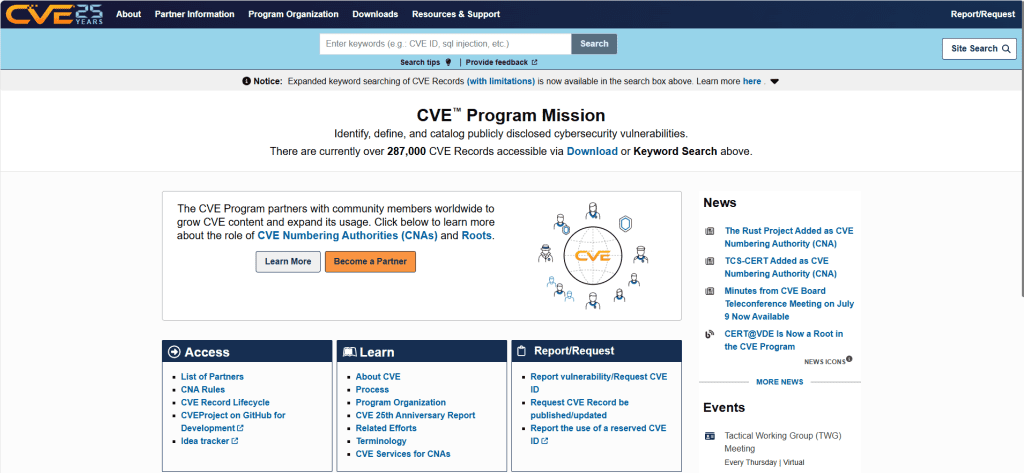
- Data is published on the official website cve.org.
- In most cases, a CVSS (Common Vulnerability Scoring System) rating is also formed — an assessment of the danger level.
[amazon_auto_links id=”8218″]
CVE Format and Structure
Each CVE vulnerability has a clear structure:
- Identifier:
CVE-YEAR-NUMBER - Brief description: technical content of the vulnerability
- Product or system: where exactly the vulnerability is located
- Vulnerability type: for example, buffer overflow, XSS, SQL Injection
- CVSS score: from 0.0 to 10.0
- Publication date
- Links to patches, PoC, workarounds
Vulnerability classes:
- Remote Code Execution (RCE)
- Privilege Escalation
- Denial of Service (DoS)
- Information Disclosure
- Authentication Bypass
Examples of CVE Vulnerabilities
1. CVE-2021-44228 (Log4Shell)
- Product: Apache Log4j
- Type: Remote Code Execution
- CVSS: 10.0 (maximum)
- Essence: allows executing arbitrary code on the server through logging certain strings.
2. CVE-2017-0144 (EternalBlue)
- Product: Windows SMBv1
- Type: RCE
- Used in WannaCry, NotPetya viruses
- CVSS: 8.1
3. CVE-2024-30992
- Product: OpenSSH (fictional example)
- Type: Privilege Escalation
- Essence: local user can escalate privileges to root through race condition in the logging system.
Consequences for Business and Infrastructure
Ignoring CVE vulnerabilities can lead to:
- Compromise of client data
- Encryption of entire IT infrastructure (Ransomware)
- Financial losses and downtime
- Fines for violating security standards (e.g., GDPR)
- Reputation loss
How to Check and Close CVE Vulnerabilities
1. Identify if your system is affected
- Check the software version and compare with vulnerable ones in the CVE description
2. Apply patches or updates
- Go to the official manufacturer’s website
- Download updates
- Make sure it completely eliminates the vulnerability
3. Use temporary measures
- If there’s no patch yet — limit functionality, change configuration, or block traffic
Tools for CVE Monitoring
Specialized services and tools are used to detect and monitor CVE vulnerabilities in systems:
| Tool | Purpose |
|---|---|
| Vulners | CVE database aggregator, supports API |
| Nessus | Professional vulnerability scanner |
| OpenVAS | Free alternative to Nessus |
| Qualys | Commercial platform with patch management automation |
| OSV (Open Source Vulnerability) | From Google for open-source dependencies |
| Shodan.io | Search for vulnerable services on the Internet |
Conclusions and Recommendations
CVE vulnerability is a serious threat to any IT infrastructure. Tracking new vulnerabilities, timely application of updates, and implementing automated monitoring are key protection practices.
Recommendations:
- Subscribe to updates from cve.org
- Implement a vulnerability management process in the company
- Use SIEM systems for incident analysis
- Continuously conduct internal audits
Similar articles – https://itorakul.com.ua/en/category/cybersecurity/