The OSI (Open Systems Interconnection) – model was developed by the International Organization for Standardization (ISO) in 1984. It is a conceptual model that standardizes communication methods in telecommunication and computing systems, regardless of their internal architecture and technologies.
Principles of the OSI Model:
Each layer performs clearly defined functions:
- The Physical layer is solely responsible for transmitting bits through the physical medium. Example: A network card converts digital data into electrical signals for transmission over an Ethernet cable.
- The Transport layer ensures reliable data delivery. Example: The TCP protocol checks if all packets have reached the recipient and requests retransmission of lost packets if necessary.
Each layer provides services to the layer above it:
- The Data Link layer provides the Network layer with reliable frame transmission services. Example: Ethernet (Data Link layer) provides the IP protocol (Network layer) with the ability to transmit packets between devices in a local network.
- The Network layer provides routing services to the Transport layer. Example: The IP protocol provides TCP with the ability to deliver data between different networks through routers.
Layers interact only with adjacent layers:
- The Application layer communicates only with the Presentation layer. Example: A web browser (Application layer) transfers data for encryption to the Presentation layer without directly interacting with the Transport or Network layers.
- The Transport layer interacts only with the Session and Network layers. Example: TCP receives data from the Session layer, breaks it into segments, and passes it to the Network layer, without knowing how the physical data transmission occurs.
Changes in one layer do not affect other layers:
- Changing the physical transmission medium. Example: Switching from copper cable to fiber optic does not require changes in higher-level protocols – TCP/IP continues to work the same way.
- Updating Application layer protocols. Example: Upgrading from HTTP 1.1 to HTTP/2 does not require changes in the operation of lower layers – TCP continues to provide reliable data transmission in the same way.
Practical example of interaction between all layers: When you open a web page:
- The browser (Application layer) forms an HTTP request
- The Presentation layer may apply encryption (HTTPS)
- The Session layer maintains the connection with the web server
- The Transport layer (TCP) breaks the data into segments
- The Network layer (IP) determines the route to the server
- The Data Link layer forms frames for transmission
- The Physical layer transmits bits over the network
Each layer performs its work independently, but together they ensure reliable data transmission from the user to the web server and back.
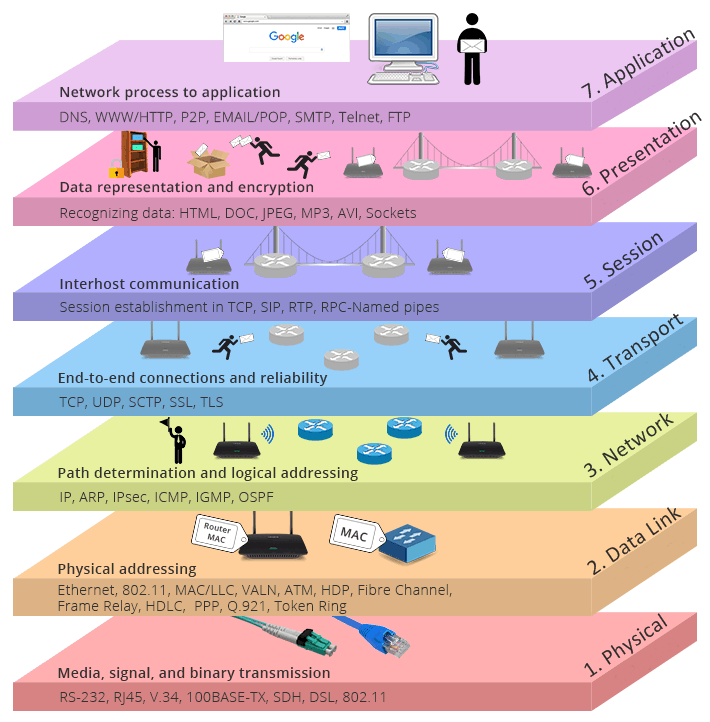
Detailed description of OSI Model layers:
1. Physical Layer
Main functions:
- Transmission and reception of unstructured bit streams
- Definition of electrical, mechanical, and functional interface characteristics
- Establishment, maintenance, and disconnection of physical connections
Equipment and components:
- Network adapters
- Repeaters
- Hubs
- Cables (coaxial, fiber optic, twisted pair)
- Plugs and connectors
2. Data Link Layer
Main functions:
- Frame formation
- MAC address addressing
- Error detection and correction
- Data flow control
Sublayers:
- MAC (Media Access Control)
- Control of access to the transmission medium
- Device addressing
- LLC (Logical Link Control)
- Ensuring transmission reliability
- Flow control
- Protocol multiplexing
3. Network Layer
Main functions:
- Packet routing
- Logical addressing (IP addressing)
- Packet fragmentation and assembly
- Congestion control
Key protocols:
- IP (Internet Protocol)
- ICMP (Internet Control Message Protocol)
- IGMP (Internet Group Management Protocol)
- IPsec (IP Security)
4. Transport Layer
Main functions:
- End-to-end data transmission
- Data segmentation
- Connection management
- Flow control
Protocols:
- TCP (Transmission Control Protocol)
- Connection-oriented
- Guaranteed delivery
- Sequence control
- UDP (User Datagram Protocol)
- Connectionless
- Fast transmission
- No delivery guarantee
5. Session Layer
Main functions:
- Establishing, maintaining, and terminating sessions
- Dialog synchronization
- Token management
- Session recovery
Mechanisms:
- Checkpoints
- Recovery after failures
- Full-duplex and half-duplex modes
6. Presentation Layer
Main functions:
- Data format conversion
- Encryption and decryption
- Data compression
Protocols and standards:
- ASCII / EBCDIC
- JPEG, GIF, MPEG
- SSL / TLS
- MIME
7. Application Layer
Main functions:
- Providing network services to applications
- Identification of communication partners
- Determining resource availability
- Communication synchronization
Key protocols:
- HTTP / HTTPS (web browser)
- FTP (file transfer)
- SMTP, POP3, IMAP (email)
- DNS (domain name system)
- Telnet (remote access)
- SSH (secure remote access)
Interaction between layers:
Data transmission process:
- Data passes from the Application layer to the Physical layer
- Service information (headers) is added at each layer
- At the Physical layer, data is converted into bits
- On the receiving side, the process happens in reverse order
Data encapsulation:
- Application layer: data
- Presentation layer: data + Presentation layer header
- Session layer: data + headers from previous layers
- And so on to the Physical layer
Practical application of the OSI Model:
ADVANTAGES OF THE OSI MODEL:
Standardization of protocols:
- Provides a unified approach to the development of network protocols worldwide
- Allows different manufacturers to create compatible equipment thanks to clear specifications
- Simplifies interaction between different network systems and devices
Modular architecture:
- Each layer can develop independently without affecting other layers
- Allows changing the implementation of a single layer without redesigning the entire system
- Simplifies the development and implementation of new network solutions
Simplified diagnostics:
- Clear division into layers makes it easy to localize problems
- Ability to test each layer separately
- Facilitates troubleshooting in the network
Layer independence:
- Each layer works autonomously and has clearly defined functions
- Changes at one layer do not affect the operation of others
- Allows parallel development of different network components
Flexibility in implementing new technologies:
- Ability to integrate new protocols and technologies without changing the entire architecture
- Support for the evolution of network technologies
- Easy adaptation to new requirements and needs
DISADVANTAGES OF THE OSI MODEL:
Implementation complexity:
- Need to create and maintain a large number of protocols
- High complexity of interaction between layers
- Need for significant resources for full implementation of all layers
Redundancy of some layers:
- Some layers may be redundant for simple network tasks
- Increased overhead for data processing
- Potential decrease in performance due to additional processing levels
Duplication of functions at different layers:
- Some security and data flow control functions are repeated at different layers
- Leads to excessive use of resources
- May create conflicts between implementations of the same functions at different layers
Mismatch with some modern protocols:
- The model may not fully correspond to modern network technologies
- Some modern protocols are difficult to assign to a specific layer
- Need to adapt the model to new technologies and protocols
Conclusion
The OSI model remains a fundamental basis for understanding network technologies and developing new protocols. Although the TCP/IP model is more commonly used in practice, the principles and concepts of the OSI model are important for learning and understanding network communications.