What is the Internet and How It Works
The Internet is a global network of interconnected computers and other devices that communicate with each other using standardized protocols. It’s not just the websites we visit daily but an entire infrastructure that allows the exchange of information between billions of devices worldwide.
History of the Internet
The beginning of the Internet can be traced back to the ARPANET project, developed in 1969 by the US Department of Defense. This project aimed to create a network that could continue functioning even if part of the network was damaged or destroyed. Over time, this network evolved, with academic institutions joining, followed by commercial organizations.
In 1989, Tim Berners-Lee developed the World Wide Web (WWW), which allowed ordinary users to easily access information through browsers. This became a turning point that led to exponential growth in Internet usage.
How the Internet Works: Key Components
1. Physical Infrastructure
At the core of the Internet lies the physical infrastructure, which includes:
- Underwater cables – huge fiber-optic cables laid on ocean floors connecting continents
- Land-based cables – including fiber-optic and copper cables
- Satellites – providing connections in remote areas
- Cellular towers – providing wireless Internet access
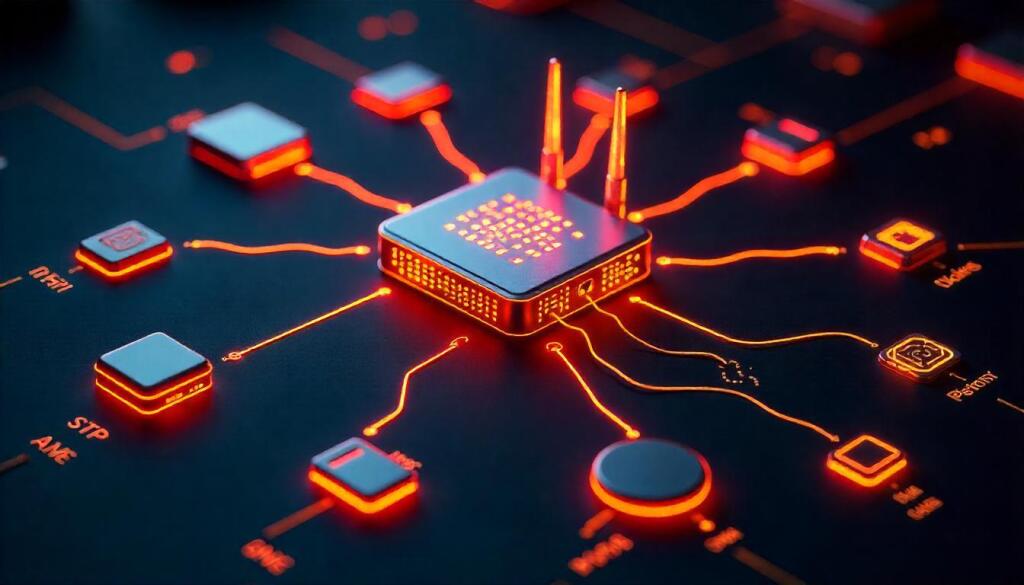
- Routers and switches – directing data along correct paths
2. Protocols
For effective communication, all devices on the Internet use standardized protocols. The most important ones are:
- TCP/IP (Transmission Control Protocol/Internet Protocol) – the fundamental set of rules governing data transmission on the Internet
- HTTP/HTTPS (Hypertext Transfer Protocol) – protocols for transferring web pages
- DNS (Domain Name System) – the system that converts domain names (e.g., google.com) to IP addresses
- FTP (File Transfer Protocol) – for file transfers
- SMTP, POP3, IMAP – for email
3. Addressing
Each device on the Internet has a unique address known as an IP address (e.g., 192.168.1.1). There are two IP address formats:
- IPv4 – uses 32-bit addressing, allowing approximately 4.3 billion unique addresses
- IPv6 – uses 128-bit addressing, allowing an almost inexhaustible supply of addresses
How Data is Transmitted Across the Internet
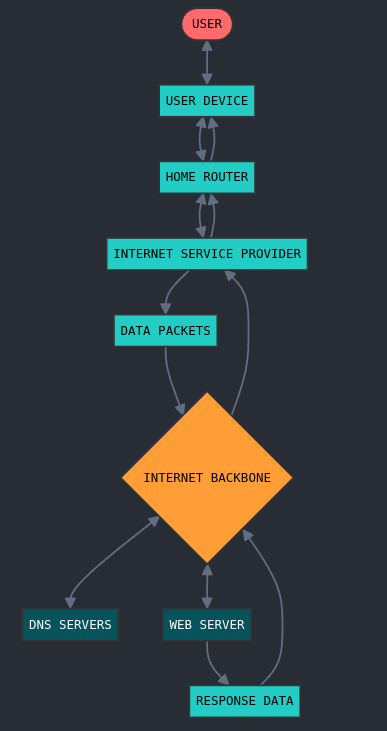
When you send or receive data via the Internet (e.g., opening a web page), here’s what happens:
- Breaking into packets: Data is broken down into small packets.
- Routing: Each packet contains the destination address and can take different paths to that destination.
- Passing through routers: Packets pass through numerous routers that determine the best path to the next “hop.”
- Reassembly: At the destination device, packets are reassembled into the original data.
This process takes milliseconds, creating the illusion of instantaneous data transmission.
Hierarchical Structure of the Internet
The Internet is organized hierarchically:
- Backbone networks – large-scale networks forming the foundation of the Internet
- Regional networks – connect to backbone networks
- Internet Service Providers (ISPs) – provide Internet access to end users
- Local networks – found in homes, offices, and other organizations
Internet vs. World Wide Web (WWW)
It’s important to distinguish between the Internet and the World Wide Web:
- The Internet – the physical network of computers, cables, routers, and other devices
- World Wide Web (WWW) – a system of interconnected hypertext documents (web pages) accessible via the Internet
The Web is just one of many services operating via the Internet, alongside email, FTP, VoIP, and others.
Modern Internet Development Trends
- Internet of Things (IoT) – billions of everyday devices connecting to the Internet
- 5G and beyond – ultra-high-speed mobile Internet
- Cloud computing – centralized data storage and computing
- Edge Computing – processing data closer to the source of generation
- Artificial Intelligence and Machine Learning – making Internet services smarter